

How Insulation Multimeters Improve NEV Three-Electric System Testing Efficiency
The global new-energy vehicle (NEV) market is expanding at an unprecedented pace, with worldwide sales hitting 23.542 million units in 2025 (Source: China New Energy Vehicle Industry Development White Paper, 2026). As NEVs become more prevalent, efficient maintenance of their core components—the "Three-Electric System" (battery, motor, and electronic controller)—has become a critical priority for service professionals. The safety and lifespan of an NEV directly depend on the condition of this system, making streamlined testing essential for modern automotive maintenance.
Why Traditional NEV Three-Electric Testing Is Inefficient
Testing the NEV three-electric system requires measuring multiple key parameters, but traditional methods rely on a cumbersome array of separate tools: voltmeters, ammeters, insulation testers, and more. Frequent tool switching slows down workflows, increases operational complexity, and creates delays—especially during on-site repairs or emergency maintenance. This inefficiency not only wastes time but also raises the risk of human error, compromising test accuracy and vehicle safety.
How an Insulation Multimeter Solves Efficiency Challenges
An insulation multimeter addresses these pain points with an integrated "all-in-one" design, combining professional insulation testing capabilities with standard multimeter functions. By eliminating the need for multiple instruments, it streamlines the entire testing process, reduces equipment costs, and minimizes tool-related delays. Today, it has become an indispensable tool for both professional NEV maintenance teams and skilled DIY enthusiasts looking to optimize their workflow.
Key Safety Standards for NEV Three-Electric System Insulation
Most NEV high-voltage systems operate above 300V, and compliance with insulation safety standards is non-negotiable. According to China’s national standard GB 18384-2020, the insulation resistance of NEV high-voltage systems must be ≥ 500 Ω/V. Below is a clear breakdown of key requirements and associated risks for major three-electric components:
System / Component | Insulation Resistance Requirement | Risks of Non-Compliance |
|---|---|---|
Battery System (e.g., 408.8V) | Must meet ≥ 500 Ω/V (e.g., 40 kΩ measurement is non-compliant) | Electric shock to operators, vehicle breakdown, and risk of battery fire |
Motor Controller Cables | ≥ 100 MΩ between positive and negative poles | Motor noise, power interruptions, and damage to the motor controller |
Charging Harness | Fast charging: theoretically infinite; Slow charging: ≥ 20 MΩ (pole to ground) | High-voltage leakage, electric shock during charging, and damage to equipment or the battery |
Step-by-Step Guide to Testing NEV Three-Electric Systems wi
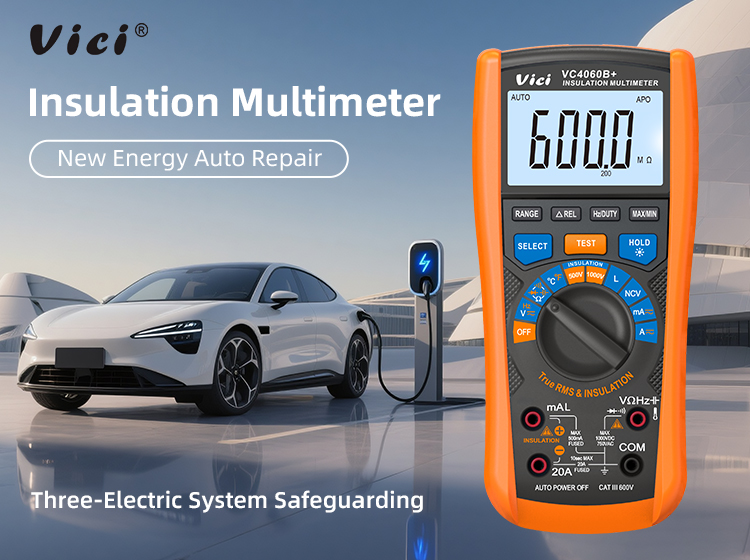
th an Insulation Multimeter
A high-performance insulation multimeter (such as the Vicimeter VC4060B+) enables one-stop testing of key three-electric system parameters. Follow these simple steps to maximize testing efficiency, accuracy, and safety:
Power Off and Discharge the High-Voltage System: Ensure the NEV is completely turned off, disconnect the high-voltage battery, and discharge any residual voltage. This critical step prevents electric shock and ensures safe testing.
Set the Insulation Multimeter to the Correct Range: Select the appropriate insulation resistance test range (typically 250V, 500V, or 1000V) based on the NEV’s high-voltage system specifications.
Perform Insulation Tests on Key Components: Test the insulation resistance between the positive/negative poles of the battery, motor controller, and charging harness relative to the vehicle chassis (ground).
Measure Additional Parameters as Needed: Use the integrated multimeter functions to test voltage, current, and temperature of relevant three-electric system components—no extra tools required.
Compare Results with Industry Standards: Validate measured values against GB 18384-2020 and other applicable industry standards to determine compliance and the overall safety status of the system.
Beyond NEV Maintenance: Versatile Applications of Insulation Multimeters
Insulation multimeters are not limited to NEV maintenance—they are versatile tools used across multiple industries. From photovoltaic inverters and energy storage systems to industrial testing and household electrical repairs, their user-friendly design makes them suitable for both professionals and skilled DIY users. This versatility adds long-term value to your tool kit, making it a smart investment beyond NEV care.
Industry Trends: The Future of NEV Testing
With the implementation of China’s Interim Measures for Power Battery Recycling in 2026 and the opening of third-party maintenance channels, demand for efficient three-electric system testing is set to grow exponentially. Multi-functional insulation multimeters are poised to become industry-standard tools, helping to standardize and professionalize NEV maintenance practices worldwide. By adopting this tool today, you can stay ahead of the curve and deliver faster, safer, and more reliable NEV maintenance.
Looking to optimize your NEV testing workflow further? Explore high-performance insulation multimeters like the Vicimeter VC4060B+ to elevate your maintenance efficiency.